COLMAP
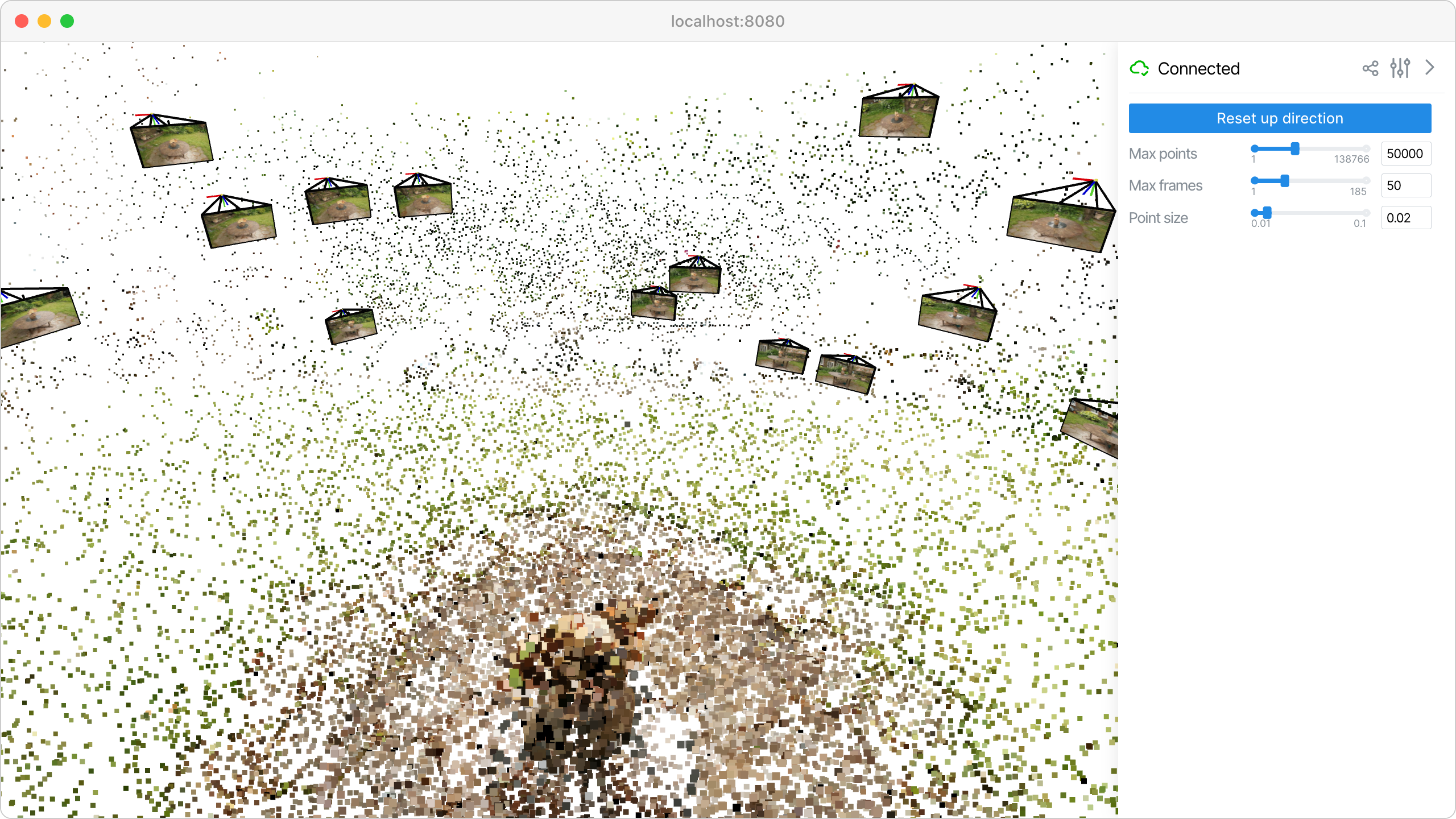
Visualize COLMAP sparse reconstruction outputs. To get demo data, see ../assets/download_assets.sh.
Features:
COLMAP sparse reconstruction file parsing
Camera frustum visualization with
viser.SceneApi.add_camera_frustum()3D point cloud display from structure-from-motion
Interactive camera and point visibility controls
Note
This example requires external assets. To download them, run:
git clone -b v1.1.1 https://github.com/viser-project/viser.git
cd viser/examples
./assets/download_assets.sh
python 04_demos/01_colmap_visualizer.py  # With viser installed.
Source: examples/04_demos/01_colmap_visualizer.py
Code
  1import random
  2import time
  3from pathlib import Path
  4from typing import List
  5
  6import imageio.v3 as iio
  7import numpy as np
  8import tyro
  9from tqdm.auto import tqdm
 10
 11import viser
 12import viser.transforms as vtf
 13from viser.extras.colmap import (
 14    read_cameras_binary,
 15    read_images_binary,
 16    read_points3d_binary,
 17)
 18
 19
 20def main(
 21    colmap_path: Path = Path(__file__).parent / "../assets/colmap_garden/sparse/0",
 22    images_path: Path = Path(__file__).parent / "../assets/colmap_garden/images_8",
 23    downsample_factor: int = 2,
 24    reorient_scene: bool = True,
 25) -> None:
 26    server = viser.ViserServer()
 27    server.gui.configure_theme(titlebar_content=None)
 28    server.gui.main_panel.dock_right()
 29
 30    # Load the colmap info.
 31    cameras = read_cameras_binary(colmap_path / "cameras.bin")
 32    images = read_images_binary(colmap_path / "images.bin")
 33    points3d = read_points3d_binary(colmap_path / "points3D.bin")
 34
 35    points = np.array([points3d[p_id].xyz for p_id in points3d])
 36    colors = np.array([points3d[p_id].rgb for p_id in points3d])
 37
 38    # Let's rotate the scene so the average camera direction is pointing up.
 39    if reorient_scene:
 40        average_up = (
 41            # `qvec` corresponds to T_camera_world; we convert to T_world_camera.
 42            vtf.SO3(np.array([img.qvec for img in images.values()])).inverse()
 43            @ np.array([0.0, -1.0, 0.0])  # -y is up in the local frame!
 44        ).mean(axis=0)
 45        average_up /= np.linalg.norm(average_up)
 46        server.scene.set_up_direction((average_up[0], average_up[1], average_up[2]))
 47
 48    gui_points = server.gui.add_slider(
 49        "Max points",
 50        min=1,
 51        max=len(points3d),
 52        step=1,
 53        initial_value=min(len(points3d), 50_000),
 54    )
 55    gui_frames = server.gui.add_slider(
 56        "Max frames",
 57        min=1,
 58        max=len(images),
 59        step=1,
 60        initial_value=min(len(images), 50),
 61    )
 62    gui_point_size = server.gui.add_slider(
 63        "Point size", min=0.01, max=0.1, step=0.001, initial_value=0.02
 64    )
 65
 66    point_mask = np.random.choice(points.shape[0], gui_points.value, replace=False)
 67    point_cloud = server.scene.add_point_cloud(
 68        name="/colmap/pcd",
 69        points=points[point_mask],
 70        colors=colors[point_mask],
 71        point_size=gui_point_size.value,
 72    )
 73    frames: List[viser.FrameHandle] = []
 74
 75    def visualize_frames() -> None:
 76
 77        # Remove existing image frames.
 78        for frame in frames:
 79            frame.remove()
 80        frames.clear()
 81
 82        # Interpret the images and cameras.
 83        img_ids = [im.id for im in images.values()]
 84        random.shuffle(img_ids)
 85        img_ids = sorted(img_ids[: gui_frames.value])
 86
 87        for img_id in tqdm(img_ids):
 88            img = images[img_id]
 89            cam = cameras[img.camera_id]
 90
 91            # Skip images that don't exist.
 92            image_filename = images_path / img.name
 93            if not image_filename.exists():
 94                continue
 95
 96            T_world_camera = vtf.SE3.from_rotation_and_translation(
 97                vtf.SO3(img.qvec), img.tvec
 98            ).inverse()
 99            frame = server.scene.add_frame(
100                f"/colmap/frame_{img_id}",
101                wxyz=T_world_camera.rotation().wxyz,
102                position=T_world_camera.translation(),
103                axes_length=0.1,
104                axes_radius=0.005,
105            )
106            frames.append(frame)
107
108            # For pinhole cameras, cam.params will be (fx, fy, cx, cy).
109            if cam.model != "PINHOLE":
110                print(f"Expected pinhole camera, but got {cam.model}")
111
112            H, W = cam.height, cam.width
113            fy = cam.params[1]
114            image = iio.imread(image_filename)
115            image = image[::downsample_factor, ::downsample_factor]
116            frustum = server.scene.add_camera_frustum(
117                f"/colmap/frame_{img_id}/frustum",
118                fov=2 * np.arctan2(H / 2, fy),
119                aspect=W / H,
120                scale=0.15,
121                image=image,
122            )
123
124            @frustum.on_click
125            def _(_, frame=frame) -> None:
126                for client in server.get_clients().values():
127                    client.camera.wxyz = frame.wxyz
128                    client.camera.position = frame.position
129
130    need_update = True
131
132    @gui_points.on_update
133    def _(_) -> None:
134        point_mask = np.random.choice(points.shape[0], gui_points.value, replace=False)
135        with server.atomic():
136            point_cloud.points = points[point_mask]
137            point_cloud.colors = colors[point_mask]
138
139    @gui_frames.on_update
140    def _(_) -> None:
141        nonlocal need_update
142        need_update = True
143
144    @gui_point_size.on_update
145    def _(_) -> None:
146        point_cloud.point_size = gui_point_size.value
147
148    while True:
149        if need_update:
150            need_update = False
151            visualize_frames()
152
153        time.sleep(1e-3)
154
155
156if __name__ == "__main__":
157    tyro.cli(main)